
Over the past 8 posts, we’ve described how proactive voice-AI agents (PVAIs) with humans-at-the-helm (aka “user-controlled services” or UCS) will transform how caregivers monitor and care for others while simultaneously enhancing the lived experience of care recipients as they age-in-place.
If you’ve read most or all, you should now understand that our vision isn’t just an incremental improvement to today’s internet and AI agents—it’s a fundamental departure from today’s normal … a complete paradigm shift!
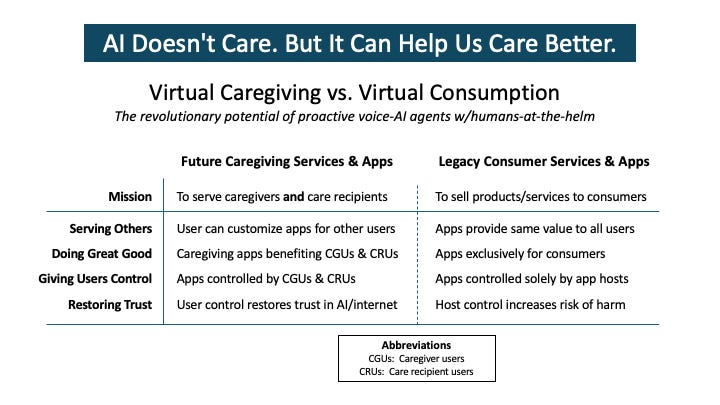
To summarize how and why our vision is such a leap forward, this post starts with a table that contrasts our proposed model of virtual caregiving—a proactive presence that is user-controlled and multi-user—with the legacy online model of virtual consumption—i.e., a self-service activity that is host-controlled and single-user.
A close read of the table should reveal why the current virtual world of AI + the internet won’t ever support caregivers and care recipients—regardless of how “intelligent” the AI becomes—without the platform extensions we envision.
An open challenge ... and an invitation
We close this introductory series with an open challenge to readers who still doubt whether proactive voice-AI agents with humans-at-the-helm will emerge to support a new class of online services that connect and serve hundreds of millions of caregivers and those for whom they care.
Consider first whether you agree that a new generation of voice-AI agents will emerge that are capable of proactively initiating dialogues with end-users that will both enhance their lives and enable them to monitor and care for other end-users of the same service?
Or, do you believe that today’s prompt-response voice-AI agents can already do some of both and will soon do much more along these lines? Or, alternatively, perhaps you still have doubts that the technical or commercial barriers to such futuristic capabilities will ever be overcome?
You may instead be comfortable with our core premise but still skeptical about the specifics. If so, what other human-AI-internet architecture or model do you envision that will enable tomorrow’s entrepreneurs and tech innovators to:
Proactively initiate conversations with care recipients based on their unique needs and patterns—without requiring them to remember to ask for help?
Leverage deep, continuous knowledge of individual care recipients—their routines, preferences, health history, and recent changes—rather than relying on generic intelligence trained on millions of people who aren’t them?
Keep human caregivers at-the-helm asynchronously—maintaining control, providing context, and exercising judgment—while an AI agent serves as their continuous presence with the care recipient?
We fail to see how today’s AI paradigm—including its push for AGI and Agentic AI (agents acting without humans)—will someday support any, let alone all, of these critical elements of caregiving and care-receiving.
Current voice-AI agents wait to be summoned. They only speak proactively if pre-prompted by an end-user (e.g., a reminder) or configured by an app owner (e.g., Alexa’s “did you know...?” prompts). They all operate on a self-service, single-user, prompt-response model where the platform owner maintains control.
Overcoming today’s barriers to virtual caregiving
Caregiving, on the other hand, requires that voice-AI agents be proactive (PVAIs) and that caregivers be able to configure them—be at-the-helm—in order to serve care recipients in an asynchronous, automated manner.
In essence, we’ve identified a structural challenge—two additions are needed to today’s AI + internet platform if it’s ever to support virtual caregiving: Proactive Voice-AI Agents (PVAIs) and User-Controlled Services (UCS).
We also can’t envision how the AI rush of today—which seems to suggest that Agentic AI will soon have knowledge of everything and be capable of any task—will produce systems that acquire and maintain the intimate knowledge that caregiving requires.
Even if an AI achieves superintelligence by training on billions of conversations, it still won’t know what YOUR 87-year-old mother needs today. Did she sleep poorly last night? Is she apt to forget an important event today? Did she take her new medication yet? Is she lonelier than usual because her daughter can’t visit this week?
Effective caregiving requires intimate, ongoing knowledge of the individual—knowledge that no generic model, however “intelligent,” can infer from training data.
This represents an epistemological challenge: the particular, contextual understanding needed for caregiving simply can’t be derived from general intelligence about millions of people who aren’t the individual being cared for.
These challenges—one architectural, one epistemological—represent uncharted territory, which is exactly why we’re excited to overcome them!
Apps or services where control shifts from platform owners to individual users who coordinate care for others ... those don’t exist yet, do they? And AI systems that already have the up-to-date, personalized, longitudinal knowledge that caregiving requires? Those aren’t on Agentic AI’s roadmap either, to our knowledge.
But they are our vision—our passion—and we are confident they will soon come to pass.
If you can envision an alternative architecture or AI approach that will bring any or all of these capabilities to the virtual world, we’d love to hear from you and learn.
If, like us, you understand why today’s AI + internet platform can’t get there without PVAIs and UCS, we invite you to follow us at www.futureofcaregiving.com as we continue building the case and the community for this critical paradigm shift that’s been hiding in plain sight!